

by Jo Kaur, Founder of Riaan Research Initiative
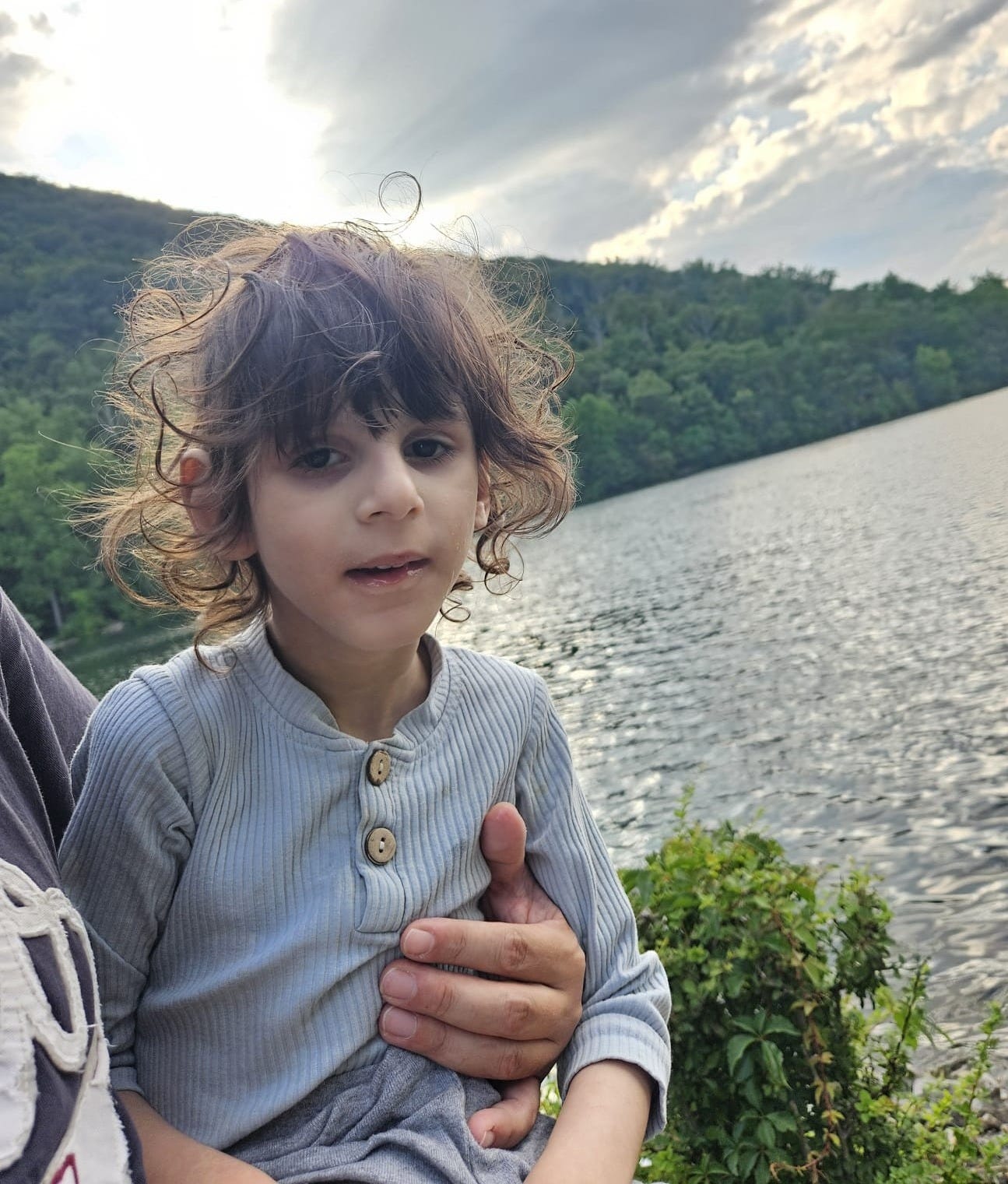
(August 26, 2025) - I took a walk with Riaan this evening, holding him in my arms, worried as always because at 5 years-old, he should feel a lot heavier than he does. He shouldn’t feel so light, like air, as I snuggle him close, breathing in the smell of his fragrant, chocolate brown hair.
We ran into one of our neighbors who is always fond of him. Riaan took a moment to steady his gaze - the nystagmus more severe today because he missed his nap - and then reached out to offer his hand. Our neighbor shook it, giving him the biggest smile, and then looked at me, his eyes full of deep sadness. He was sad while looking at Riaan. There was no mistaking it. To him, Riaan did not look well. He could see the marks of the disease trying to chase my little boy to the grave.
We walked away, and I felt hot tears rolling down my cheeks, a reaction I didn’t expect and could not control in the moment. You see, we had a similar incident just last week, except it was at a doctor’s office - a specialist’s clinic. As the physicians and research assistants crowded into the room, very kind, knowledgeable, and friendly, I saw the way they looked at him and talked about him. They didn’t see him as Richie or I see him: a perfect little boy, full of awareness and life. Now they did see his humanity but they also saw his sickness, in a way that we as his parents don’t. I felt a stab of irrational anger: how dare they?
Yet in my heart of hearts, I know the disease is progressing. I know the neurons are dying. I see him zone out from time to time, and as much as I convince myself it’s a moment of wisdom, of ultimate enlightenment, and maybe it is, that’s not entirely it either.
So my fleeting moment of rage was irrational, yes, but it was visceral and shaped our interactions. We parents of children with severe rare diseases always think our children look and are healthier than they are, we always describe them as stable. This can create tensions with healthcare providers.
I once thought this was a feeling only I had but I came upon this study from Boston Children’s Hospital that instantly made me feel less alone: “I Could Never Prepare for Something Like the Death of My Own Child”: Parental Perspectives on Preparedness at End of Life for Children With Complex Chronic Conditions.
I made myself jump into the abyss, and read the entire thing in one sitting, more hot tears flowing down my cheeks.
We will never be prepared for the death of our child. It is not possible.
We describe our children as stable even right before the very end. In our heads they are healthier than they seem to others.
We are always waiting for that miracle. Many of us think it will come. The alternative is just not possible. How can it be?
We will never fully accept or be ready, no matter how many hospital visits there are.
And I don't know this pain yet and I hope I never do but the end is beyond our worst nightmares. The last horrific gasps, as both souls leave their bodies, parent and child.
I don’t know how anyone survives this pain, how they’re strong enough to deal with the intensity of it. Many bereaved parents go on to do tremendous, beautiful things with their lives. But I cannot even conceptualize having that kind of strength.
It’s why I fight as hard as I can now because the world after is a barren land where I am likely destined to wander, a haunted soul, full of grief and turmoil. I wish, of course, that I was stronger.
This kind of experience - people say it makes you more resilient. I don’t know. I think it does in different ways for people. But for others, we become noodles, we cannot tolerate more pain.
There is a lot of pressure to be hopeful and positive, and usually I am, primarily because of Riaan and what he has taught me. People also don’t want to interact with a perpetual ball of sadness. It’s too overwhelming for most, and I understand that. It would probably be too overwhelming for me if I wasn’t sitting where I am now. Now I yearn to be around this level of awareness; I need to be around people who have or are experiencing similar pain and grief because our shared understanding decreases the isolation.
But there’s bad days, there’s dark days, there’s days when you don’t think you can keep up appearances, and you see how frail your child has become, how the months and years bring immense change, when all you want to do is stop the clock. Except for the treatment development clock — that one needs to accelerate! Perhaps then we can live on an exquisite planet where time passes slowly as Riaan and I just gaze into each other’s eyes, embracing the pure, unconditional, sacred love that defines who we are while the scientists in the hovering spaceship nearby work at light year speeds to get the treatments ready.
Even in these dark moments though, my will and belief in Riaan, and the actual hope behind the work to develop treatments, is unyielding. Exciting progress is being made, and while we can’t move at the speed of light, the fact that we are moving toward the sun at all is breathtaking. The light at the end of the tunnel awaits.
***
My dear friend Winty Singh is riding 200 miles in one day for children with Cockayne syndrome. This will be his fifth #Ride4Riaan for Riaan Research Initiative. There is incredible hope in the research and the path forward. A labor of love inspired by Riaan and for the benefit of the beautiful children within the CS community. We need your help and support to file our Investigational New Drug application, and get us to clinical trials. Donate here. We can’t do this without you!